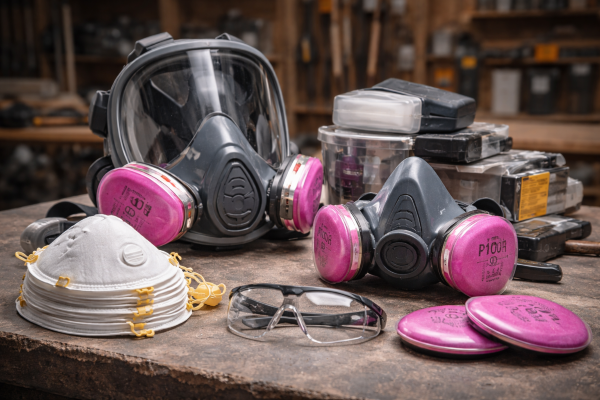
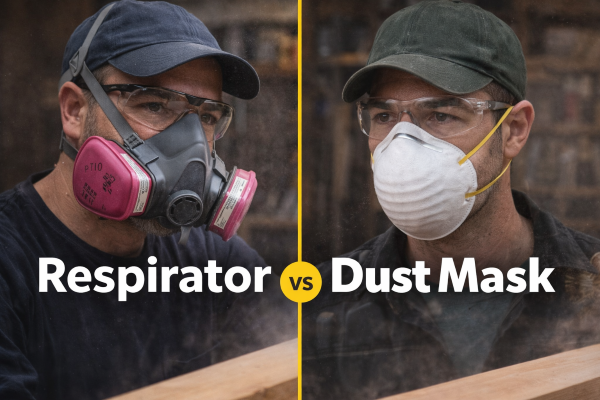
If you’re working around dust, fumes, or airborne particles, you’ve probably seen both dust masks and respirators. At first glance, they look similar, but they offer very different levels of protection.
Choosing the wrong one can leave you exposed without realizing it.
This guide breaks down the real differences so you can choose the right protection for your work.
Quick Answer
A dust mask provides basic protection against larger particles, while a respirator creates a sealed fit and uses replaceable filters to protect against fine dust, fumes, and hazardous air.
For serious work like woodworking, painting, or construction, a respirator is the better choice.
What Is a Dust Mask?
Dust masks are lightweight, disposable masks designed to filter out larger particles like:
- sawdust
- pollen
- general debris
They are easy to use and inexpensive, but they have limitations.
Pros:
- cheap and easy to use
- lightweight
- good for light dust
Cons:
- loose fit (air leaks around edges)
- limited filtration
- not suitable for fumes or chemicals
Dust masks are best for quick, low-risk tasks.
What Is a Respirator?
A respirator is designed to create a tight seal around your face and uses filters or cartridges to protect against much smaller and more dangerous particles.
Respirators are used for:
- woodworking and sanding
- painting and solvents
- construction work
- confined spaces
Pros:
- tight seal for better protection
- higher filtration (P100, N95, etc.)
- reusable options available
Cons:
- more expensive
- requires proper fit
- slightly less comfortable for beginners
Key Differences (Simple Breakdown)
Fit
Dust Mask: loose, gaps around edges
Respirator: tight seal, minimal air leaks
Protection Level
Dust Mask: basic particle protection
Respirator: advanced filtration (fine dust, fumes, vapors)
Reusability
Dust Mask: disposable
Respirator: reusable with replaceable filters
Best Use
Dust Mask: light, short-term work
Respirator: regular or heavy exposure
Which One Should You Use?
Keep it simple:
- Light dust or quick jobs → dust mask is fine
- Woodworking, sanding, or heavy dust → use a respirator
- Fumes or chemicals → respirator only
If you’re unsure, it’s safer to go with a respirator.
Recommended Respirators (For Real Protection)
If you’re working with dust regularly, here are solid options to consider:
Best Overall

AirGearPro G-500 Reusable Respirator Mask with A1P2 Filters, Gas Mask Ideal for Painting, Woodworking, Construction, Sanding, Spraying, Chemicals, DIY etc
DUAL FILTRATION SYSTEM (A1P2): Our gasmask is designed with a dual filtration system of class A1P2 to guarantee your protection against gases, vapours and particles. The anti-gas cartridges filter out organic gases and vapours with boiling points above 65°C. The P2 dust filter filters at least 95% of airborne particles.
* As an Amazon Associate I earn from qualifying purchases. Prices may vary.
Best Budget Option

3M P100 / OV / AG Multi-Purpose Reusable Respirator 62023 Medium Size NIOSH-APPROVED P100 / Organic Vapor / Acid Gas Rated Filters
NIOSH-APPROVED OV/AG/P100 RATED filters for at least 99.97% filtration efficiency against solids and liquid aerosols, as well as oil-based particulates
* As an Amazon Associate I earn from qualifying purchases. Prices may vary.
Best for Comfort

3M 6300 Large Face Piece For 6000 Series, Black/Grey
Designed to cover your nose and mouth to provide comfort while working in moderately polluted environments
* As an Amazon Associate I earn from qualifying purchases. Prices may vary.
Common Mistake to Avoid
A lot of people use a dust mask thinking it’s enough for everything.
The problem:
- it doesn’t seal properly
- fine dust still gets through
- fumes are not filtered at all
This creates a false sense of safety.
Final Thoughts
Dust masks have their place, but they’re limited.
If you’re doing any serious work—especially woodworking or working with fine dust—a proper respirator is the better choice.
It protects your lungs, lasts longer, and gives you real protection instead of just basic coverage.

3M 8511 Particulate Disposable Respirator, N95, Pack of 80, NIOSH Approved, Cool Comfort and Fewer Pressure Points with Dual Attachment for Grinding, Sanding, Sawing, Sweeping, Dust, Smoke
BREATHE EASIER: Highly charged microfibers enhance the capture of airborne particles while allowing you to breathe easier APPLICATIONS: Grinding, sanding, sweeping, sawing, bagging, or other dusty operations as well as wildfire smoke inhalation
* As an Amazon Associate I earn from qualifying purchases. Prices may vary.