Why Your Welding Helmet Is Your Most Critical Tool
In welding, visibility and safety are two sides of the same coin. A low-quality lens doesn’t just make for a sloppy weld; it leads to “arc eye” (photokeratitis) and long-term retinal damage. With auto-darkening technology and “True Color” optics advancing rapidly in 2026, choosing a helmet is no longer just about shade—it’s about clarity, weight distribution, and sensor reliability.
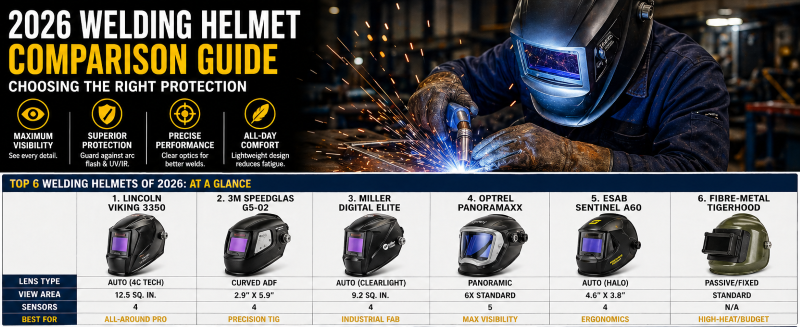
Top 6 Welding Helmets of 2026: At a Glance
| Model | Lens Type | View Area | Sensors | Best For |
| Lincoln Viking 3350 | Auto (4C Tech) | 12.5 sq. in. | 4 | All-Around Pro |
| 3M Speedglas G5-02 | Curved ADF | 2.9″ x 5.9″ | 4 | Precision TIG |
| Miller Digital Elite | Auto (ClearLight) | 9.2 sq. in. | 4 | Industrial Fab |
| Optrel Panoramaxx | Panoramic | 6x Standard | 5 | Max Visibility |
| ESAB Sentinel A60 | Auto (Halo) | 4.6″ x 3.8″ | 4 | Ergonomics |
| Fibre-Metal Tigerhood | Passive/Fixed | Standard | N/A | High-Heat/Budget |
Key Features to Compare

1. Auto-Darkening Filter (ADF) vs. Passive
- Passive (Fixed Shade): Reliable and inexpensive. Best for long sessions of the same welding process (e.g., stick welding).
- Auto-Darkening: Adjusts from a light state (usually Shade 3) to a dark state (Shade 5-13) in milliseconds. Essential for “tack” welding and multi-process shops.
2. Optical Clarity (The 1/1/1/1 Rating)
Look for the EN 379 rating. A “perfect” score is 1/1/1/1, representing:
- Optical Class: Distortion-free view.
- Diffusion of Light: No blurring.
- Variations in Luminous Transmittance: Uniform shade across the lens.
- Angle Dependency: Consistent shade even when looking at an angle.
3. Number of Arc Sensors
Cheaper helmets use 2 sensors; professional models use 4 or more. More sensors mean the helmet is less likely to “flash” you if a sensor is blocked by a pipe or your own arm during out-of-position welds.
Industry-Specific Recommendations

- For TIG Welding: You need a helmet that can detect low-amp arcs (down to 2-5 amps). The 3M Speedglas G5-02 or Miller Digital Elite are the gold standards here.
- For Industrial Construction: Look for ANSI Z87.1+ impact ratings and hard-hat compatibility. The Optrel Helix series is specifically designed for these rugged environments.
- For High-Volume Fabrication: Weight matters. Choose a helmet with a high-quality “headgear” system (like the ESAB Halo) that pivots to balance the weight over your center of gravity.
Safety Maintenance Checklist
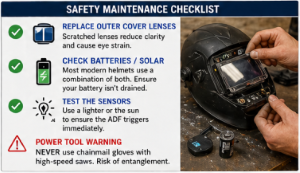
- Replace Outer Cover Lenses: Scratched lenses force your eyes to work harder and reduce clarity.
- Check Batteries/Solar: Most modern helmets use a combination of both. Ensure your battery isn’t drained before starting a shift.
- Test the Sensors: Use a lighter or the sun to ensure the ADF triggers immediately before you strike an arc.
Final Verdict: Which One Should You Buy?
If you are a professional looking for the best balance of optics and value, the Lincoln Viking 3350 with 4C Lens Technology remains the 2026 frontrunner. For hobbyists or those on a budget, a passive Fibre-Metal helmet offers indestructible protection without the high price tag.

ANDELI Auto Darkening Welding Helmet with Light-Full Digital Filter, 7.2\"x3.2\" Extra Wide Panoramic View, Type-C Fast Charging True Color Wide Shade 4/5-9/9-13 for Weld Cut Grind
【Dual Modes LED light】This rechargeable LED light features USB fast charging and low power consumption for long-lasting use. With an adjustable angle and waterproof design, it offers dual lighting modes—a wider beam for broad area illumination and a focused beam for precision welding tasks.Ideal for assisting welders with enhanced clarity in diverse welding conditions.
* Some links in these cards may be affiliate links. I may earn a commission at no extra cost to you. Prices may vary.